
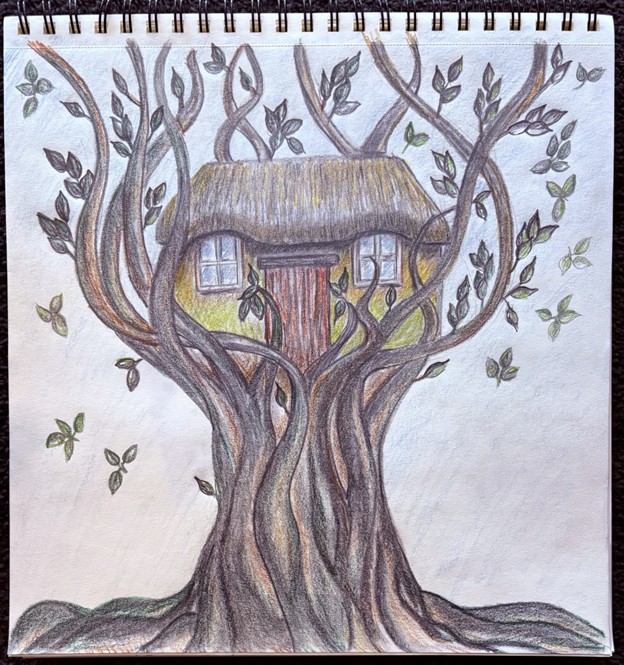
Especially with a view to colleagues joining on April 16th for an online EMDR Learning Community Discussion on Attachment as Lens in EMDR, I’m posting here with permission a rather moving and powerful case study built on a piece of in-person dreamwork in Melbourne, Australia in February.
It’s quite long, but as an illustration of how powerful attachment-informed EMDR can be, is worth the read.
A room that wants to be entered: dreamwork with Michelle
Of all the ways that EMDR processing can unfold, dreamwork is often one of the most powerful, and in our wider community, still relatively poorly understood. This case study follows a piece of work with a colleague we’ll call Michelle across two sessions: a live in-person demonstration early 2026 in Melbourne, Australia, and a follow-up session online a month later. Between them, our two meetings illustrate much of what I try to teach about working with dreams within an attachment-informed EMDR framework.
What makes this work distinctive is the way dreams function not as simply random nightmares to be desensitised, or just an unsettled night after eating too much cheese for dinner, but as communication from an individual nervous system — an invitation, constructed often over decades, to enter a story that wants to be known.
Dreams use metaphor, wordplay and imagery to encode experiences that the conscious mind has long since filed under “just stuff that happened.” The therapeutic task is not to interpret the dream first from outside, but to enter into it together with the client, with EMDR’s bilateral stimulation, and to follow where it leads.
In her early fifties, mother of two adult children and married to a former military man, Michelle is warm, direct, courageous, and possessed of what she later describes as a very vivid imagination. A native of the English North Sea port city of Hull, she emigrated to Australia in her early 20s and now an EMDR therapist herself has been following my work online for some time.
Melbourne: the live demonstration
The workshop’s afternoon session has been devoted to EMDR interweaves — the full range of clinical tools available within ai-EMDR processing: curiosity interweaves, relational interweaves, intergenerational interweaves, truth interweaves, the non-dual interweave, rescue interweaves, the Transfer of Perspective and what I with only pasrt of my tongue in my cheek call the “WTF” interweave.
The day before and on the morning of our concluding demo, I have been teaching and illustrating these with clinical examples, building towards a piece of live work that serves as a final taking-the-brakes-off of what can be done with attachment-informed EMDR. With 50 or so therapist colleagues drawn up around us in a circle of compassionate curiosity, we begin.
Resourcing
I start the active work where I always start, identifying with Michelle a rich and imaginal resource team. Her suggestions come quickly, and with vivid particularity. Her Special Place is a little red brick cottage with a thatched roof, white windows, and ivy growing over the wall — hashtag “cottage.” Her Nurturing Figures are a very tall, big, brown mama bear with round eyes, a white pit bull terrier she calls Pretty Pitty, and her maternal grandfather. Her Protective Figures are a lioness — though “actually, it’s only the eyes, because she’s watching over me” — a dragon, a knight in silver armour on horseback, and her husband Mike. Her Wise Figure is a long-legged owl with glasses. “Male or Female?”, I ask, as I always do when a figure’s sex is not immediately clear. “Wisdom doesn’t need to have a gender,” she says. I agree.
We tap them in, and the work is quick, perhaps five minutes. As I say to the group, what is useful about this part of ai-EMDR is that these characters are actually already there. We don’t need to “install” them as if from outside, one of many terms in classic EMDR that’s well past its sell-by date. All we are doing is opening the curtains, or, as it were, rubbing Aladdin’s lamp to summon the Genie inside.
The dream
Before Michelle and I begin, I have explained my approach to the group: dreams are invitations from the Unconscious to explore and heal —Freud’s Royal Road, and neon-lit gateways into stories that speak to and from an individual’s core identity and their sense of self in the world.
In the approach I have taken from my own training in transpersonal psychotherapy, the client is invited to tell the dream slowly in the present tense, eyes open, as if it is happening in the here and now. The therapist writes this down word for word, ready to be read back as closely to how the client has reported it as possible.
Michelle tells me of nightmares from childhood, but the dream she wants to work on is a recurring one she’s had since her mid-twenties. It’s has morphed over time, but has a constant core architecture. She gives me two versions, a current dream and in an earlier form.
In the latest dream she is, as she always is, in a house with several storeys (or stories perhaps? Dreams know how to signal meaning with how differently words are spelled.) It’s night time and dark. Lights are on, but the staircase is unlit, and there’s a closed door at the top leading to a room which in one dream version is tiled and in another iteration has just bare walls and carpet. There are two entrances — a way in and a way out, through which Michelle would need to go through to reach other parts of the house. She feels a pressure to enter, but dreads stepping over the threshold.
Since the dreams began 30 years ago, she has been through that door only a handful of times — and each time it is sheer terror. Both in the dream and then on waking, Michelle is frozen, unable to move, with eyes wide open in the dark. Over years of lucid dreaming, she has learned to stop herself entering the room, or to wake herself at this point, often finding herself sleep-paralysed from head to toe with buzzing in her ears and pressed down as if by the weight of the deepest ocean.
Aware how important it will be in our work to invite Michelle now for the first time to enter that room and connect with its message, but keeping that thought to myself as I faithfully note down her words, I ask Michelle to close her eyes, I then read the dream slowly back to her exactly as she has told it, asking her simply to notice, not its worst part as might be done in standard EMDR, but where the energy is. When I finish, she is clear that it’s the dread as she stands before the room, knowing she will be trapped if she enters.
The dome and the ghost
Inviting Michelle now just to notice what she notices, I start the bilateral stimulation that’s EMDR’s power tool, tapping her rhythmically – about heartbeat speed – on the outside of her knees. After the first couple of sets, each of a very rough 25 seconds, she reports seeing a white dome over the top of the room — soft, partly covering it, creating a space where she can breathe. Something is banging inside the dome, but she does not know what. She is shaky and tingly.
Knowing in this model that all parts of a dream are dimensions of the client’s self, I decide to use what I call the Transfer of Perspective, also from my transpersonal supervision training rather than from the EMDR canon of interventions, asking Michelle to imagine her conscious awareness rising gently up out of herself as dreamer, hovering gently above the story unfolding below and looking down on the dome, the houses, and herself on the threshold of the steps. Which part of the landscape, I ask her, is most urgently inviting her to drop down and explore.
It’s the room.
Now, I say, imagine your perspective dropping gently down into the body and the being of the room, with access to what it can see, and to its thoughts, feelings and experience. What comes next is raw and immediate. “Nobody can hear me,” she says. “It doesn’t matter how loud I shout. Nobody can hear me. I’m trapped. I can’t get out. No one’s coming.”
Aware that the dome and the room will be holding a story from Michelle’s childhood previously unsafe to be remembered consciously, and relating to the room as itself a conscious being with experience memory and voice, I ask the room to turn its attention back towards Michelle’s past, and using here the standard target-identification language of the ai-EMDR bridge, to “Drop back in time, to go back as far as you can, to when Michelle was a little kid. Where do you land?”
The room lands us lands in Michelle’s childhood aged two. She is in a cot, a baby girl in a white babygrow that is too small — toes squished at the end, the fabric pulling at her neck. There are bars on the cot, a double bed and a cast-iron fireplace painted blue. It’s daytime outside, and it is light. The door is locked.
And there is a ghost in the room.
Here in our training room in 2026 Melbourne, with 50 of her colleagues watching, Michelle says the ghost is real. It terrifies her. I ask whether I can approach the ghost. She says yes. “Hello, ghost!” I say. “What is your story? What do you want us to know? What are you holding on Michelle’s behalf?”
After a set of tapping, the answer comes: “I don’t care. I don’t give a shit.” However, the ghost has changed — it is black now, with ripples. I press further, using the well-established language of the Neuro-Linguistic Programming in which Francine Shapiro, founder of the EMDR approach, was steeped. What, I ask the ghost, is your benevolent intent? And the full message, in the colourful and precise language of now-adult Michelle emerges: “There’s no point in shouting. Don’t shout. Nobody cares. Nobody’s coming. You’re on your own. You’ve just got me, and I’m scary as fuck.”
This is the kind of moment where the Transfer of Perspective is an especially useful clinical tool. The ghost, terrifying to a two-year-old shut away in her bedroom, is in fact holding a survival message: stop crying, stop shouting, because there is nothing you can do and you will only exhaust yourself. In the circumstances, I reflect to Michelle, this might be quite wise advice. The ghost is modelling how to survive the unsurvivable.
Locked in
The full story emerges. From the age of approximately two to eleven, Michelle was literally locked in her bedroom every night by a mother who was, on the one hand, terrified that her sleep-walking child would hurt herself if allowed to leave the room, and on the other who would go out every night to either her own mother’s nearby house or to the pub. Michelle would therefore be put to bed, the door was locked, and as a child she would lie awake listening for the sound of the front door opening and her mother’s return.
Nine years. Every night. A child on her own behind a locked door, with a ghost that told her not to bother shouting because nobody was coming.
I explain to Michelle and to the group that when a two-year-old is left alone and locked in, that is existential. That child is going to fear for their life. On the plains of Africa two hundred thousand years ago in our shared evolutionary history, a two-year-old without a carer is a hyena’s supper. The nervous system does not know the difference between literal abandonment and being locked in a room in Hull. The survival response is the same.
Michelle adds, quietly: “I had a really happy childhood. Lots of good stuff happened.” And she means it. She has been a child who explored and investigated, who loved books and woods and mud and climbing. Her maternal grandparents were warm and present. But what’s also true is that she was locked in her bedroom every night between the ages of two and eleven, with the weight of the deepest ocean sitting on her chest ever since.
Rescue
Before the childhood memory surfaces, Michelle’s resource team has already begun to mobilise. In this session of under an hour, we are at what I teach as a tipping point, when Reveal needs to shift towards Rewire and Repair with the resource figures tapped in as therapy commences ready to support what needs to happen. When I ask whether anyone on the team can open the door, the impact is dramatic and immediate. Her knight gallops up and smashes the window. The mama bear squeezes her enormous body through the opening — so big that Michelle can no longer see the window behind her. When I ask what the bear wants to do, Michelle says: “She wants to rip the door open.” And she does. The bear rips the bed out and throws it through the window, overturns the cot then gets her fingers round the door frame and tears a hole in the wall.
A Chinook helicopter has also arrived in the imagery, landing on the backyard wall — Michelle’s husband is ex-military, and the Chinook represents power, rescue, the capacity to go into a war zone and bring people out. Pretty Pitty, the white pit bull, jumps in and nuzzles against little Michelle in the cot. The lioness stands behind, her eyes watching over.
The resource team is not decoration. It is the client’s own internal capacity for protection, nurture, and agency, activated and brought to bear on a story where none of those things were available at the time. The violence of the rescue — the smashed window, the ripped door — is agency finally being exercised where it was once impossible.
Entering the room
With the team around her, I invite Michelle in classic EMDR structure “back to target”, to where her dream started— to the threshold of the room she has in her nighttime terror never been able to enter. I ask, would it be safe to go in? She says: “Maybe. The room is calling me. I’m curious about it.” So, cautiously, in her imagination and mine and with mama bear and the lioness walking beside us, we go in together.
Michelle gets through the first door, but sticks on the second. So once again understanding every aspect of a dream as a living and conscious part of self, I address the door directly. “Hello, door. Is there anything you need from us?”
The door obligingly opens, and Michelle is no longer afraid to step through.
The room is white and tiled. It looks, she says, rather clinical. I ask whether she has any childhood memory of a clinical space with white tiles. She suddenly connects with the memory at five of chasing the family cat past an armchair where her mother is sitting. Her mother grabs her arm to stop her, but holds so tightly that the child spins round, smashing her mouth on the wooden frame of the chair, studded with little brass tacks. Her teeth are not knocked out but pushed up inside the gum. Her mother takes her to the dentist to have the debris cut out, pinning her down while the dentist works.
“I can’t move,” adult Michelle tells me. “Nobody’s listening. I’m not screaming. I’m not saying anything.”
So as clear as day, there’s the theme of paralysis again, of being held down. Michelle’s nervous system remembers being physically locked in place, both at the dentist and behind her childhood bedroom door, by the person who was supposed to protect her. I notice at this point how Michelle pulls her dress across to cover her throat, and choose to name it: the body is remembering something the throat wants to say. The connection lands. What is the quality of a tooth, I ask? White. Hard. Shiny. “Is it like a tile?”
The dream has been playing with this metaphor for decades. White tiles in the room; white teeth in the dentist’s chair. The hard, glossy surface that the dreaming mind uses to encode a memory it cannot yet speak directly. This is how dreams work: they do not hand you the story on a plate. They make you work for it. They play with words and images and associations, and they wait — if necessary for half a century and more — for someone to come in and follow the trail.
As we process with EMDR’s bilateral stimulation, tapping her knees, Michelle’s imagination peels the fingers off that little child — the dentist, the mother, everyone who has held her down — and chucks them off. The bear picks her up. And then the grief and the tears come: held so long, by the ghost, by the tiles, by the dream itself.
The room transforms
I ask what Michelle is getting now. She remembers the room, she says, but now it’s just a dentist’s empty black chair and there’s no-one there. I offer an interweave: what would it be like to see this room of her dream as a space that holds memories which may or may not want to be explored further. What it be like to say to the room: thank you. You have been holding so much memory and emotion for me, until it was safe to come back and reclaim them.
“Thank you for holding this,” Michelle says. “That’s what I want to say to the room.”
I tap, and the tiles transform. They become in Michelle’s imagination little windows and little doors — tiny openings, each one a gateway to a different memory. The big door that has always trapped her is now wide open. “I can get out,” she says. “It’s always been there. I can always get out. But I didn’t know that before. I was trapped. Locked in the room, and held down on the dentist’s chair. But I’m not trapped any more. I can go into my memories, and I can go through them and come back out the other side.”
The babygrow
Noting that all of this is happening within the one 45-minute session, I am careful as I always am to work within EMDR’s containing structure, and we return to target, to the two-year-old in the very first image and the bedroom.
I have an idea. Might little Michelle need a bigger babygrow. The old one – both literally in memory and metaphorically, is constraining her, pulling at her shoulders and squashing her toes. More than half a century later, Michelle has herself long been a mother and she understands immediately. Of course little Michelle needs a new babygrow, which is now not only the right size but has dragons on it, and a tail. There is space to grow. The child hops out of the cot. The door of the bedroom is gone. The bedroom is no longer attached to the house.
This may sound like imaginative play, but it is not. The metaphor of the babygrow is doing real work in the nervous system. As a child, Michelle was constrained — literally, by the cot and the locked room and the too-small garment; figuratively, by the programming that told her she could not move, could not grow, could not get out. Giving her a babygrow now with dragons on it — one of her own protective figures — that fits properly and has room to expand, is a direct communication to the child part that the constraint is over.
The iPad interweave and the sweep
To close the Melbourne session, I use two final interweaves, first, the iPad. I ask Michelle to go back to the two-year-old and the eleven-year-old and show them pictures of her future self, because those children did and do not know that it is going to turn out all right. Then to conclude the session, my own imagination prompts me to suggest to Michelle that together with the big bear she spread her arms out and sweep up all the little Michelles — the two-year-old, the eleven-year-old, all the aspects of self that got left behind. “Hey, kids. You’re home now. I’ve got you.”
High-fiving each other with relief and delight as we turn to the debrief, Michelle says there’s a part of her thinking that if she’d known she was going to go all the way there in this piece of live work before a large group, she wouldn’t have done it. “Actually,” she adds, “I now look back at my childhood, and there’s a lot of good stuff there. It’s just something that happened to me.” And then: “The most poignant part was that the room became almost like a library. The tiles — little tiny doors and windows and books. And I’ve got this curiosity now.”
It is the library of your past, I say. A great place to go rifling through the books. And you can put books back on the shelf, and get on with your life.
One more thing emerges. Michelle says: “My mama bear — I’ve just realised — is actually me.” Of course it is. Of course, the fierce, enormous, protective bear that rips the door off its hinges is the mother that Michelle herself became — the woman who, at seventeen, had her first child and has been fiercely protecting her family ever since.
The follow-up session: 30 March 2026
A month later, with me now back in the UK, Michelle and I meet again online to take the work forward. She tells me that the night after the demo, she had slept badly — or rather, as I later suggest, she sleeps very well, but spends much of it in REM sleep, doing what her nervous system needs to do: processing decades of stored material. The dreams that come over the following nights are remarkable.
Dream one: the Long House
The first night after the demonstration, Michelle dreams she is again in a house. It’s pitch black but she can feel the framework. Even though she cannot see, she knows where she is going. The doors are now all open. It is a single-storey house, vast, room after room after room, like, she says, a long flat factory. The rooms are at first pitch black, then she begins to notice the beams: ten-inch-by-ten-inch thick wooden pillars, old, weathered, greyish hardwood — the kind of oak that has been holding things up for a very long time. And they are snapped. Not cleanly cut, but splintered — long fingers of broken wood. Room after room, every beam snapped. And then fire. The splintered beams begin to burn, and the rooms go from black to orange.
She is not frightened. She keeps looking, curious rather than afraid, until a voice says: “We should probably leave now.” I am struck by that “we”. She reflects: she is a lucid dreamer, and there is a dual attention operating within the dream — the Michelle who is having the experience and the observer self who is watching. “We’ve seen what we need to see,” the voice says. She finds herself outside, standing on a slight slope, looking down at this vast, flat-roofed building with spots of fire coming through the windows and the roof.
The imagery is extraordinarily rich. A house whose hidden framework has been holding things up for a very long time, but is now breaking, splintering, catching fire. The old oak pillars — the defences, the structures that kept everything in place — can no longer hold. This is what happens when deep processing begins: the infrastructure that maintained the old organisation starts to give way. And the fire is not destruction; it is transformation. Old wood, burning. And it is the first dream of the rest of her life.
Dream two: Morrill Street, and the tree house
The second night, Michelle sleeps well. Her dream now comes in two parts, bridged by a recurring image from her life.
There is a street in Hull called Morrill Street. Michelle lived there from the age of thirteen to seventeen, in a house where her father — a violent man — beat her and, as later emerges in our session, would sometimes nail the windows shut, keeping her confined for weeks at a time. In the recurring Morrill Street dream, she is in the street, either at the top or bottom end. She knows her house is there, but she never looks at it. She is never uncomfortable, just waiting.
I am struck, when Michelle tells me this, by the name. Morrill Street. However you spell it, the ear hears “moral.” And dreams, as I teach repeatedly, play with words. There is indeed a moral to her story.
In Michelle’s dream, an American friend from her adult life appears, a woman with whom she has in the past had deep and meaningful conversations. Sam is standing opposite the house, and they are talking. The dream then shifts: Michelle steps out of Morrill Street and finds herself in a clearing. Lush green grass. At the bottom of the clearing, an oak tree — not one tree but several wound and twisted together, branches reaching down and then curling up again. And held in the branches of this living oak is a house, a beautiful thatched cottage with little windows and roses climbing up the wall. Peaceful, safe and hers (and also, of course, figuring as her special place weeks earlier when we were setting up EMDR’s Phase Two resourcing).
Michelle draws a picture of it when she wakes up. And then she tells me something that sends a shiver through me: she has been drawing the same image since primary school. A little field, little trees in the background, a little house with little lights on. Always in the corner of pages. Always giving her joy. She has drawn that picture a thousand times without knowing why.
I now ask Michelle to close her eyes and to join Sam in her imagination outside that Morrill Street house where she lived from thirteen to seventeen and where her father was violent. Michelle is curious about what Sam is saying, so again using the Transfer of Perspective, I invite her conscious awareness to rise up out of the dream, to look down on the street, the house and the scene, and to drop down into the body, being and perspective of her friend. Sam is, of course, an aspect of Michelle herself: a wise, mature woman with the capacity to observe experience also from the outside. Accessing Sam’s perspective allows Michelle to approach and enter the house from a position of dual attention.
Within twenty seconds of tapping, memory surfaces. Michelle needs to tell Sam about something that happened in the street. Her father once punched her so hard she fell under a car, picking her back up by the throat. We stay with it. Brief sets, 20-25 seconds at most. Inside the house, there is more that needs to be acknowledged. Michelle sits with it, chooses not to share the details — “we know there was more, and that’s okay” — and then actively chooses to leave.
What happens next is extraordinary. Michelle doesn’t just leave, but finds herself slamming the door and screaming: “You don’t scare me anymore! You can nail as many windows down as you like. It doesn’t matter.” She remembers how her father used to nail the windows shut, looking at her through the glass as he did so, and now, all these years later, just as the bear did in her first dream of earliest childhood (note, with its nails, that word again), adult Michelle smashes the window and tells the house it no longer holds power over her.
The house is so much smaller
From outside, with Sam beside her, I now invite Michelle to look back into the Long House dream — the splintered beams, the fire. The shift is immediate. “The house is so much smaller,” she says. “It’s actually other people’s house. It’s their shit. It was my dad’s shit, it was my mum’s shit. It was never mine to carry.”
I reflect, “Well, you did carry it for a long time, which is what kids do. Which is where you were a good girl.” Something softens. A warm memory surfaces: grandmother, granddad, Auntie Barbara. Christmas parties and visiting her grandparents every day — they lived at the top of her terrace. The “good Yorkshire stuff” alongside the terrible.
And then a little girl appears. Little Michelle, in her black shoes and pulled-up socks and a little cardigan. Happy as Larry, free and playing. From a child who was locked in a bedroom from two to twelve, and whose father nailed the windows shut when she was a teenager. Now free, and playing.
Running to the tree house
With just a few minutes of the session to go, I cast the narrative forward. From Morrill Street to the oak tree and its thatched cottage. Michelle steps through a door into the green clearing — and she is running. White socks and sandals, running through the long grass like the little girl from Little House on the Prairie, hopping through the field. As I tap, and with eyes still closed as the EMDR processing continues, she climbs the tree easily, no ladder needed, and jumps up onto a branch. “The tree is mine,” she says.
She clambers through the back window of the cottage and settles into the sofa. In the image she is about seven or eight. Safe. Arrived. “It’s all mine,” she says. “This is all mine.”
“You have indeed arrived,” I say. “You’re safe. You have earned this, Michelle. I really mean that. What a journey.”
The view from above
To close this extraordinary session, I invite Michelle’s conscious awareness to rise back up gently out of the child on the sofa and to hover over the entire landscape of her journey. There is Morrill Street. There is the earlier house where she was locked in the bedroom from two to twelve. There is the Long House with its splintered beams and fire. There is the tree house. And there also is the room of the first dream we explored in Melbourne, with its tiles and its library. All of it is visible from above.
The oak tree, she says, is not just in a field. The field goes round, and the tree is on top of the world. On top of her world, with all the stories and difficulties feeding the tree. “I feel strong,” she says. “And proud. I’m good enough. I always have been.”
We tap that in sand Michelle describes feeling as though she has gained an extra three inches to breathe — literal, physical space in her chest.
What this work illustrates
Several things stand out from this piece of work, and I want to name them explicitly because they go to the heart of what I teach.
First, there is the power of a single session to initiate deep processing. The Melbourne demonstration lasted indeed just forty-five minutes, from a standing start. No therapeutic history, no formulation, no assessment beyond what emerged in the room. Within that time, we accessed a dream that has been recurring for thirty years, bridged from it to a childhood memory of being locked in from the age of two, met a ghost that turned out to be a survival mechanism, entered a room the client has never been able to enter, discovered that the tiles are teeth and the teeth a dentist memory, watched the room transform into a library, and brought the child home. And then the nervous system kept processing for weeks afterwards, producing two further dreams of extraordinary clarity and precision.
Second, there is the role of dreams as the nervous system’s own processing language. A recurring dream is not a random nightmare, but an elaborately constructed invitation, using in Michelle’s story the architecture of houses and rooms and doors to encode the actual experience of being locked in.
There is the metaphor of tiles and teeth and of the ghost as survival mechanism. The two entrances offer a way in and a way out, if only she can find it. The dream has been trying to get Michelle to do this work for decades. It uses every trick in the book, including, as I say to her, bringing her to a workshop in Melbourne where someone happens to be demonstrating dreamwork.
Third, the Transfer of Perspective is a most useful clinical tool. In Melbourne, rising over the landscape of the dream to see its architecture from above allowed the bridge to emerge naturally. In the follow-up, dropping into Sam’s perspective gave Michelle a position of dual attention from which she could approach a house she was too frightened to enter alone. Sam in the dream is of course Michelle herself — her wise self, her observer self, the “we” that is present in the Long House dream. The Transfer of Perspective is not a trick. It is a way of activating the client’s own capacity for dual attention, and that’s at the heart of EMDR.
Fourth, there’s the economy and discipline of proactive interweaving. Across these two sessions, we covered the recurring dream, the childhood memory of being locked in, the ghost, the dentist, the tiles-to-library transformation, the babygrow, the iPad interweave, the sweep, two subsequent dreams, the Morrill Street house, the father’s violence, the Long House, and the tree house. It’s a lot of territory. It is possible because each interweave is brief, targeted, and follows the emerging material.
Fifth, there’s the somatic reality of the processing. Michelle is emphatic: this is not just cognitive. “It’s really physical,” she says. “It’s almost like you’re there again.” She can feel the grass whipping against her legs as she runs to the tree house. She can feel the lock releasing inside her after Melbourne. She can feel the extra three inches of breathing space after the follow-up. The body is not a metaphor in this work but the primary site of change.
And finally, there’s the image Michelle has been drawing since primary school: a little field, little trees, a little house with lights on. She has drawn that picture a thousand times without knowing why. It was always there, waiting. The dream knew before she did that this is where she was heading. The cottage in the oak tree, on top of the world, is the destination her nervous system had been pointing towards all along.
Jocelyn Rose, a colleague who has written on EMDR and psychedelics, was my dream demonstration volunteer on Part 2 the previous year. She said afterwards that the experience was the closest thing to a psychedelic journey she had ever had without actually taking the substances. I think she is right. What bilateral stimulation does, in the context of this kind of proactive, imaginative, attachment-informed work, is to light up the brain in ways that connect things which have been disconnected. It is transformative and does not require a protocol that ties up the guru’s cat.
I’ll tell you that story another day.
Coda: the dreams keep coming
A few days after I send Michelle the draft of this case study, she writes to say she has been having more dreams. Reading about her own processing has itself become a form of dual attention — observing her experience from outside, which reactivates the material. The nervous system, it seems, is not finished.
The first dream comes the night she reads the draft. She is in her own kitchen, in the dark. A shadow is blocking her way out. It says: “I have found you now. There are monsters in the dark.” No sleep paralysis this time — just a creepy feeling on waking. She knows she is dreaming because there are no lights on the microwave or the fridge, and she wakes herself from it without difficulty.
The architecture is familiar: a dark space, a figure blocking the exit, the theme of being trapped. But notice what has changed. There is no paralysis. She wakes herself cleanly, without the weight of the deepest ocean pressing her down. The system is already less frozen. And “I have found you now” is not only a threat — it is also the unconscious saying: now that this story has been written down and witnessed, I can reach you properly.
The second dream, the following night, is entirely different. Bright oranges, yellows and reds. A large, multi-level open space — almost like a shopping mall or a big airport. She is being pursued by a monster, a very large and oddly shaped one, but she can see it and it is not very fast. All the people in the airport are helping her. It is not very scary at all, she says, just curious.
The arc from dream one to dream two closely mirrors the arc of the two sessions: from dread and paralysis to curiosity and agency. Dark to bright, trapped to open. Alone to helped, terrified to curious. The monster is visible, slow, odd-shaped — no longer the overwhelming ghost in the room or the shadow blocking the kitchen door. And there are people helping. The nervous system is doing the work.
Michelle asks me in her email whether she is barking mad, and whether some people only process during dreams. The answer to the first question is a very solid no; to the second, yes. REM sleep is the brain’s own processing system, and EMDR appears to activate something very similar. For someone with Michelle’s vivid imagination and decades of lucid dreaming experience, the dream state can be where the deepest reorganisation happens. Bilateral stimulation opens the door. The dreams walk through it. Her lucid dreaming capacity, which she used defensively for thirty years to wake herself before entering the room, is now operating productively. The observer self — the “we” in the Long House dream — is the same dual attention that makes EMDR work. She already has the machinery, and we just switched it on.
Reading back through her own story, Michelle adds one more observation that catches something important. “I know it’s not exaggerated,” she writes, “but I am a light-hearted and measured person emotionally. Saying my truth feels right now, but it has to be correct and not more than it was.” She corrects several details in the draft — the dentist memory happened at five, not six; her father nailed the windows shut a few times, keeping her confined for four to five weeks each time, rather than continuously from thirteen to seventeen. “Yes, that’s really bad enough,” she writes. “I fully understand. But it’s important.” It is important. Her insistence on precision — this happened, but not more than it was — is itself clinically significant. For a woman whose childhood involved other people’s distortions imposed on her reality, owning the truth exactly as it was, neither inflated nor minimised, is an act of agency.
“It’s strange to think I really did have a great childhood,” she reflects. “There were just some proper shitty parts mixed in.”