
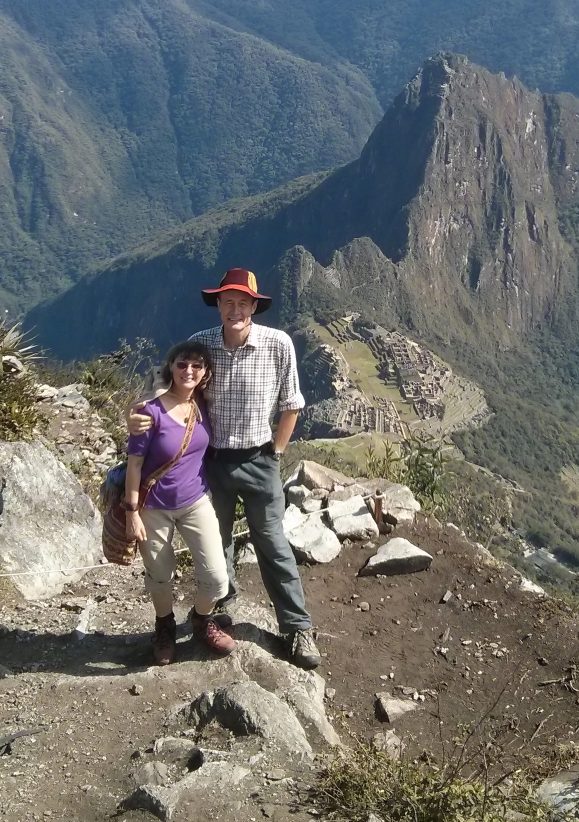
Mark and Jutta on Machu Picchu, just before she said Yes, the second time.
EMDR with both partners…
A couple in difficulty is two nervous systems in constant conversation. Each partner is now the other’s primary adult attachment figure, and each reads the other through what they learned to expect as children. In a split second, a tone of voice, a look or a single word can fire the survival response, and, with time, can destroy relationships.
On Sunday 22 November, Mark Brayne joins Rotem Brayer’s EMDR Learning Community for a live online workshop on bringing attachment-informed EMDR (ai-EMDR) directly into the work with couples. It is the first in a planned series of specialist ai-EMDR seminars with the ELC.
We’ll look at how to help each partner find for themselves those moments of recurring conflict that fire their nervous system, whether at the height of the tension or in the bracing before it, running the scene tightly backwards and forwards until that moment shows itself. This then becomes the bridge back to each partner’s formative root. One partner is the client, while the other witnesses and does the tapping.
Colleagues at our earlier couples workshops told us that watching a partner hold the tapping changed the level of compassion in the room. Mark will demonstrate the framework step by step in a short live role play (without any actual processing) with two volunteers, and there will be time for practice in small groups.
Date: Sunday 22 November 2026
Time: 09:00 to 12:30 Mountain Time (08:00 to 11:30 Pacific, 11:00 to 14:30 Eastern, 16:00 to 19:30 UK), with two short breaks
Format: live online on Zoom, hosted by the EMDR Learning Community
Price: early bird US$97 until the end of Sunday 25 October (Mountain Time), then US$117
Credits: 3.5 EMDRIA credits applied for, pending approval, for live attendance only
Recording: every registered participant has access to the recording for a year
Who this workshop is for
EMDR therapists who have completed their basic EMDR training, and especially colleagues who also work with couples, whether from an EFT/EFCT, Gottman, Imago or PACT background. No previous training in ai-EMDR is needed, and ai-EMDR works within the eight phases and three prongs of the standard protocol.
What you’ll learn
By the end of the workshop, participants will be able to:
- describe how adult partners act as each other’s primary attachment figures, and how this shapes reactivity in conflict;
- guide each partner, by running the scene tightly backwards and forwards, to the split-second moment in a recurring conflict that fires their nervous system;
- apply the ai-EMDR bridge (image, emotion, body, belief, then drop back in time to the first place the client lands) in a silent joint exercise with both partners;
- work with one partner as client while the other witnesses and provides the tapping under the therapist’s guidance;
- recognise when conjoint EMDR is appropriate, and when individual therapy or referral is needed;
- use the intergenerational extended interweave to help one partner make sense of a reaction to the other.
How the session runs
We begin with couples as two interacting nervous systems, the partner as primary adult attachment figure, and the ai-EMDR frame for couples: the seven targets on the 1+3+3 map, the nervous system as a prediction machine, the four layers of formative experience, and reveal, then repair and rewire. Mark will also say a little about his and Jutta’s own journey as a couple.
A first short exercise looks at a recurring flashpoint in a couple from your own caseload. We then walk through the couples framework step by step, from joint psychoeducation and the silent joint bridge to the resource team and the partner as tapper, with a live short demonstration of the principles and then a debrief.
In the second short breakout, you’ll walk through the couples structure yourselves. We then come back together to look at contraindications for conjoint work (an affair in progress, coercive control or violence, secrets, active dissociation), when to refer, and your questions.
Credits, recording and registration
3.5 EMDRIA credits have been applied for and are pending approval. They are included in the registration fee, and are available only to colleagues who attend live; viewers of the recording are not eligible. Everyone who registers has access to the recording for a year, whether or not they can join us on the day.
Registration is through the EMDR Learning Community, and the early bird price of US$97 runs until the end of Sunday 25 October, Mountain Time.
Volunteers for the role play
The demonstration is a role play, showing the mechanics of the couples framework step by step rather than working with anyone’s own material. If you and a colleague or partner would be willing to take the two roles, please get in touch. Volunteers are briefed beforehand and give consent in advance to being recorded.
About Mark
Mark Brayne is an EMDR Europe-Accredited Consultant, an EMDRIA-Approved Consultant and Credit Provider, and a UKCP-registered psychotherapist, supervisor and couples therapist, with more than 17,000 clinical hours. Before retraining, he spent thirty years as a Reuters and BBC foreign correspondent and editor. Through EMDR Focus he has trained more than 1,000 clinicians internationally in attachment-informed EMDR.
He is the author of Unleash Your EMDR: Release the Magic. His most recent paper, co-authored with Christine Ramsey-Wade et al, is Attachment-Informed EMDR: Framework and Illustrative Case Study (Counselling and Psychotherapy Research, 2026), the first peer-reviewed account of the ai-EMDR framework.
About the EMDR Learning Community
The EMDR Learning Community is an online community for EMDR therapists founded by Rotem Brayer, LPC, an EMDRIA-Approved Consultant and author of The Art and Science of EMDR. Rotem hosts the workshop and looks after Zoom, the breakout rooms and questions in the chat.
Background reading on Mark’s earlier thinking about this work is in EMDR with Couples.
You must be logged in to post a comment.