
EMDR with Focus on Attachment and Early-Life Formative Experience: a Paradigm Shift
Three days in-person in Denver with Mark Brayne
At a glance
- Dates — Thursday to Saturday, August 27–29, 2026, 09.00 to 17.00 each day
- Venue — Greenwood Village Training Space, 6200 S Syracuse Way, Greenwood Village, CO 80111
- Format — One continuous three-day immersion: teaching, extended live demonstration of ai-EMDR with volunteer participants, and pair practice with facilitator support
- Cost — US$447. One registration covers all three days.
- CE credits — 12 EMDRIA Credits for Days 1 & 2, 6 EMDRIA Credits for Day 3, for a total of 18, with corresponding NBCC credit. Two EMDRIA approval numbers, two certificates, one experience.
- Registration — Check out Jackie Flynn’s booking page here.
Three days, one immersion
Denver in August will be the first time attachment-informed EMDR has been taught in a fully immersive three-day in-person format anywhere, not just in the United States, bringing together teaching, live demonstrations, and supervised pair practice.
Days 1 and 2 establish the six core elements of ai-EMDR: case conceptualisation across the four levels of formative experience, rich and imaginal resourcing, bridging from the present back to the formative target, the modified Phase 3 sequence and the use of imaginal and relational interweaves in a clear and focused frame of session structure.
Day 3 deepens into what Mark calls his extended interweaves (there are after all quite enough protocols already): working intergenerationally as a session within a session, working with parts of self, and working with dreams as gateways into sa client’s formative stories long waiting to be addressed.
Theory is illustrated throughout by live demonstrations with volunteer participants, and attendees will have space to practise the work for real in pairs with as much facilitation as we can muster.
That is what makes Denver different from a two-day training with a masterclass tacked on. It is one piece of work, learned in one room, over three days.
Continuing education
For continuing-education purposes, the three days are structured as two EMDRIA-approved trainings — Core Concepts and Session Structure (12 EMDRIA Credits, Days 1 and 2) and Clinical Demonstration and Applied Decision Making (6 EMDRIA Credits, Day 3) — for a total of 18 EMDRIA Credits with corresponding NBCC credit. One registration link, one experience, two certificates as administrative convenience.
A paradigm shift, not a replacement
Attachment-informed EMDR builds on Francine Shapiro’s eight-phase Standard Protocol and complements rather than replaces it.
Participants will leave with tools that strengthen the EMDR they already know and extend its reach into the formative material which standard targeting can find difficult to access.
What used to travel just under the banner of “attachment-informed EMDR” is now sharpened and restated as a paradigm shift: from trauma-focused to formative-experience-focused, from rupture alone to rupture and the absence of repair, from “what happened” to the wider question of how this person came to be the way they are. That reframing is what the three days are built around.
As Gabor Maté says, “Trauma is not what happens to you, but what happens inside you as a result of what happens to you.” ai-EMDR helps us work with what the nervous system learned to do to survive, whether the presenting issue feels big or small.
Who this is for
This training is for EMDR-trained clinicians who work with attachment-related distress, developmental trauma, and chronic patterns of dysregulation, and who want their sessions to feel more contained, coherent and complete.
You are trained in EMDR. You know the protocol. And still, when attachment wounds and developmental trauma are associated with persistent nervous system dysregulation, EMDR can feel slower and less predictable. Targets are less clear. Activation can become overly cognitive or exceed the client’s window of tolerance. Sessions can lose structure or end without a clear sense of completion, even when you are careful and aligned with the model.
The three days in Denver are designed for that clinical territory.
By the end, participants will have more clarity about what is organising the client’s current presentation, how to resource first so the system has enough support for processing, how to bridge from present-day triggers to meaningful developmental targets, how to activate without flooding or going overly cognitive, how to support repair when processing stalls, and how to end sessions with containment and present orientation.
Days 1 and 2 — Core Concepts and Session Structure
Day one takes a clean walk through the core of the model. Case conceptualisation across the four levels of formative experience. Rich and imaginal resourcing — the Team, not just the Safe Place. The modified protocol with its Image-Emotion-Body-Belief activation sequence, a felt-experience alternative to SUDs and Validity of Cognition numbers that tends to be less destabilising for attachment-wounded clients.
We spend careful time on bridging as the central methodology for moving from present activation to developmental memory, using the Magic Question as the tool that cuts through noise and chatter and takes the work, when done well, unerringly into the root stories.
Day two moves from model to room. We re-walk Phase 4 as the Three Rs — Reveal, Repair, Rewire — and the tipping point between letting the story show itself and moving proactively to repair.
We pay careful attention to pacing and prosody, to set length and speed, to the Goldilocks principle of when to return to target, and to how each session holds together as a complete sequence, from present issue through bridge, landing target, processing, tipping point and back over the bridge to future template.
The Noise-to-Signal model sits alongside the Six Principles of ai-EMDR — Case Conceptualisation, Rich and Imaginal Resourcing, Target Identification, Appropriate Activation, Reveal-Repair-Rewire, and Session Structure — as the clinical map for why complex and stuck cases so often need this reframing to begin moving.
Pair practice runs through both days, supported by facilitators, so participants leave not only having seen the work but having done it.
Day 3 — Extended Interweaves
The third day deepens into the extended interweaves and into clinical decision-making in real time. Mark works with volunteer participants in extended live demonstrations, explaining his reasoning as he goes, while the group tracks the decision points and the rationale behind them.
The day moves through three particular extensions of the work: the intergenerational extended interweave, where the session contains within it a smaller session — a meeting, in imagination, between the client’s young self and the formative figure they need to address; parts of self, where dissociated or split-off aspects of experience are met and integrated within the session; and dreams, treated not as residue but as gateways.
Participants will leave with more clarity about:
- how to track capacity and shifts in nervous system regulation as the session unfolds;
- how to recognise when processing is moving, stalled, or becoming overly cognitive;
- how to make cleaner choices about pacing, focus and intervention within the standard EMDR protocol;
- how and when attachment-informed imaginal and relational interweaves can support repair and continuation of processing;
- and how to return the client to present orientation with containment and completion.
How the days are taught
Teaching is clear and focused, as Mark explains his clinical reasoning as he works, so participants can see how decisions are made moment by moment.
Important note: this training is delivered in person. We’re considering how simply to enable remote access, live and recorded, but if it happens, be aware that this will be done without great sophistication.
Venue, cost, CEs and logistics
The three-day workshop costs just $447, with 18 CE credits from both EMDRIA and NBCC and is being held at the Greenwood Village Training Space, 6200 S Syracuse Way, Greenwood Village, CO 80111 — a calm and well-appointed training space in the Denver metro area.
Each day runs 09.00 to 17.00.
Delegates are responsible for their own travel and accommodation; Denver International Airport is well connected, and Greenwood Village is easily reached from downtown Denver and from the airport.
About Mark Brayne
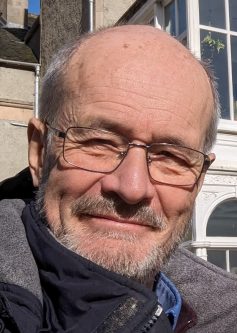
Mark Brayne is an EMDR Europe-accredited and EMDRIA-approved consultant, a UKCP-registered psychotherapist, Director of EMDR Focus Ltd., and a former BBC and Reuters foreign correspondent.
He is the author of Unleash Your EMDR — Release the Magic and has taught attachment-informed EMDR across the UK, Europe, the United States, Australia and New Zealand.
His current work is a restatement of the ai-EMDR model as a paradigm shift — an invitation to look beyond trauma to the wider landscape of formative experience that shapes how each person learned, in their earliest years, survive, and not always to flourish.
About Jackie Flynn
With warm thanks to Jackie Flynn — EMDRIA-approved consultant, trainer, and long-time champion of play, expressive arts and EMDR — for hosting the event, and for the care she is bringing to the logistics and to the room.
You must be logged in to post a comment.